


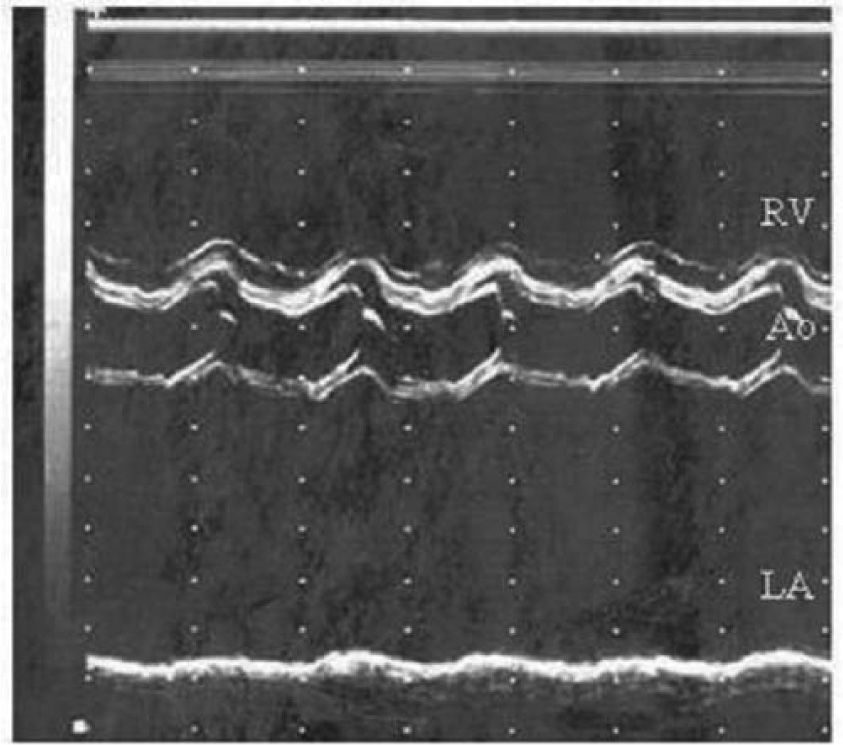
A 35-year-old man, with a history of left atrial (LA) enlargement (Figure 1) diagnosed in childhood while studying a febrile syndrome (LA 4.7cm/m2), presented with worsening heart failure symptoms. There was no previous congenital or acquired valve disease, including rheumatic valve disease, cardiac shunt or Ebstein anomaly.
From the age of 20 his electrocardiogram had shown atrial fibrillation. The chest X-ray revealed severe cardiomegaly with elevated left main bronchus. The two-dimensional transthoracic echocardiogram (Figure 2) demonstrated massive atrial enlargement (LA 456ml and right atrium 172ml), giving a dwarfed appearance to the normal-sized ventricles. Biventricular systolic function was preserved; mitral inflow showed a restrictive pattern and moderate mitral and tricuspid regurgitation were noticed. Severe pulmonary hypertension was present.

For further assessment, cardiac magnetic resonance imaging was performed, which provided additional evidence of severe biatrial dilatation, with the atrial septum bulging markedly to the right, and no interatrial shunt (Figure 3A). The other echocardiographic findings were confirmed. Late gadolinium enhancement (LGE) imaging, acquired 10 minutes after gadolinium administration, revealed diffuse biatrial LGE as well as focal LGE in the anterolateral papillary muscle (Figure 3B).

Cardiac magnetic resonance imaging in four-chamber view: 3A - cine steady-state free precession sequence further confirming severe biatrial dilatation, with the atrial septum bulging markedly to the right; 3B - phase-sensitive inversion recovery (PSIR) sequence obtained 10 minutes after gadolinium administration demonstrating diffuse biatrial late gadolinium enhancement (LGE) as well as focal LGE in the anterolateral papillary muscle.
Endomyocardial biopsy from the right ventricle demonstrated degeneration of myocardial fibers and moderate interstitial fibrosis (Figure 4), with no inflammatory cell infiltration.

Despite optimized therapy, the patient's clinical status remained unstable and he underwent heart transplantation. Histological analysis of the explanted heart showed no abnormalities other than slight lymphocytic infiltration. After one year of follow-up, he reported significant symptomatic improvement.
Idiopathic bilateral atrial enlargement is a rare congenital entity1. Myocarditis has been identified as contributing to its pathogenesis2. In this case, diagnosis of LA enlargement following a febrile syndrome in childhood, without valvular or myocardial disease, suggests that inflammation might be involved in this massive biatrial dilatation.