

Suggestions
Share
Journal Information
Vol. 42. Issue 9.
Pages 813-814 (September 2023)
Vol. 42. Issue 9.
Pages 813-814 (September 2023)
Image in Cardiology
Full text access
Percutaneous implantation of a Sapiens 3 valve-in-valve in mitral position: A case report involving correction of prosthetic mitral valve regurgitation
Implantação percutânea de valve-in-valve Sapiens 3 em posição mitral: um caso clínico de correção de regurgitação de prótese valvular mitral
Visits
2498
Miguel Martins de Carvalhoa,b,
Corresponding author
, Ricardo Alves Pintoa, Tânia Proençaa, Mariana Paivaa, Carla Sousaa,b, João Carlos Silvaa, Filipe Macedoa,b
a Department of Cardiology, Centro Hospitalar Universitário de São João, Porto, Portugal
b Cardiovascular R&D Center, Faculty of Medicine of the University of Porto São João, Porto, Portugal
This item has received
Article information
Full Text
Bibliography
Download PDF
Statistics
Figures (1)
Additional material (2)
Full Text

Currently, the treatment for most valve diseases requiring intervention is surgical; and there are unmet clinical needs in patients who are inoperable due to high surgical risk. This is the case of up to 49% of patients requiring mitral valve intervention.1,2

We describe the case of an 85-year-old man who underwent mitral replacement surgery with a biological prothesis (Carpentier-Edwards SAV 29) in 2011. In October 2020, he developed signs of heart failure. An echocardiogram was performed, revealing severe mitral bioprosthetic regurgitation, due to cusp prolapse (Video 1); preserved biventricular systolic function and major pulmonary hypertension. Due to his advanced age, frailty and having undergone previous cardiac surgery, the risk of new surgery was deemed too high. The decision was taken to perform a percutaneous mitral valve-in-valve implantation of a Sapiens 3 Ultra-29. The valve was inserted via transseptal puncture, with transesophageal echocardiogram and fluoroscopy guidance (Video 1). During valve deployment, rapid ventricular pacing was applied. After valve implantation, a small peri-prothesis leak was observed. There was no interference with the adjacent cardiac structures (Video 2); the mean transvalvular gradient was 5mmHg. The patient improved and was discharged five days later.

Biological valves are being used increasingly,3,4 however, their longevity is shorter and the consequently the number of patients with degeneration of bioprosethic valves will increase. The balloon-expandable Sapiens 3 valve is designed to be deployed in a rigid structure, so that the radial force of the balloon expanding valve provides support.2 This procedure should be considered in high surgical risk patients (Figure 1).
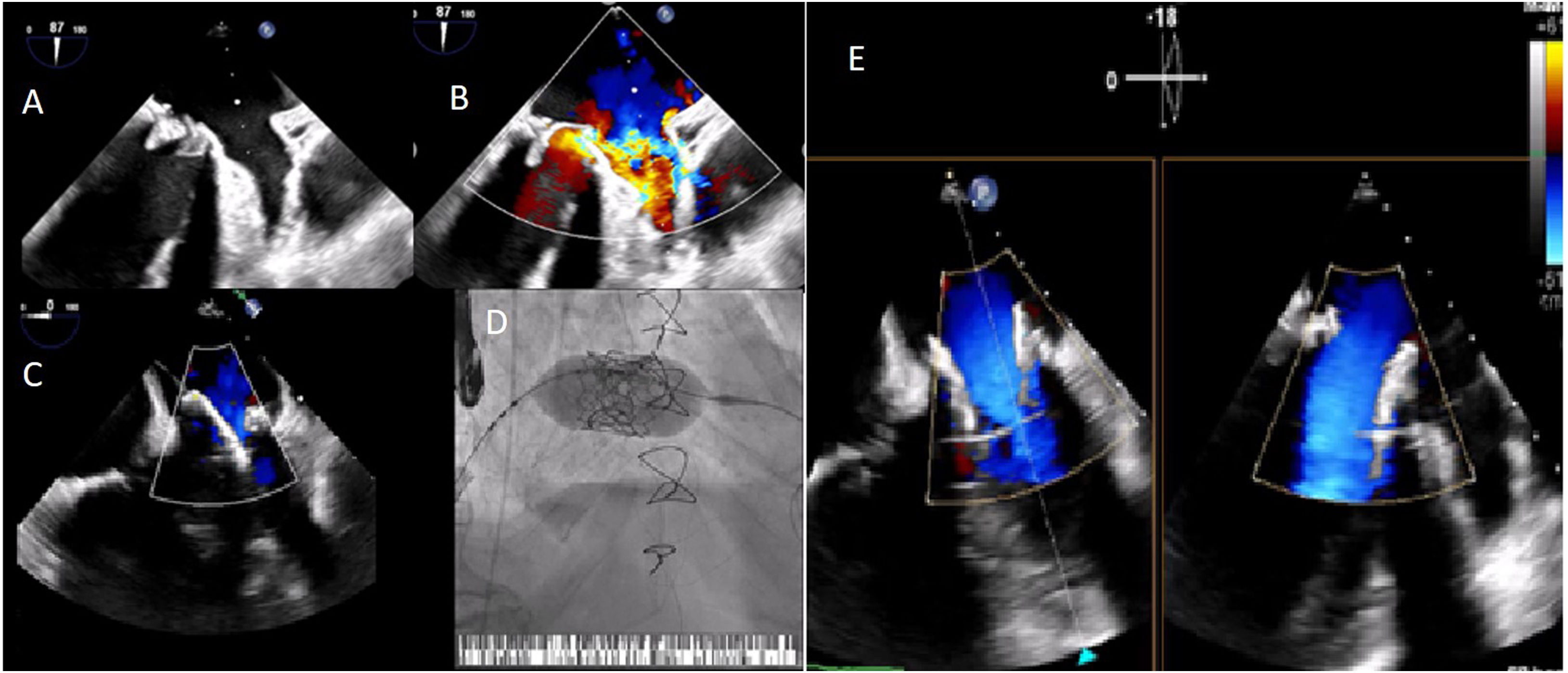
Figure 1.

(A and B) Severe mitral prothesis regurgitation due to cusp prolapse, jets directed posterior-laterally and to the left atrial appendage; implantation of an Edwards Sapiens 3 Ultra-29 valve, with transesophageal echocardiography (C) and fluoroscopy (D) guidance; (E) final result: no signs of interference in the adjacent cardiac structures; a small lateral peri-prothesis leak was observed.

Conflicts of interest

The authors have no conflicts of interest to declare.

Appendix A
Supplementary data

The following are the supplementary data to this article:

(3.56MB)
(0.34MB)

References
[1]
M. Mirabel, B. Iung, G. Baron, et al.
What are the characteristics of patients with severe, symptomatic, mitral regurgitation who are denied surgery?.
Eur Heart J, 28 (2007), pp. 1358-1365
[2]
R. Puri, O. Abdul-Jawad Altisent, M. del Trigo, et al.
Transcatheter mitral valve implantation for inoperable severely calcified native mitral valve disease: a systematic review.
Catheter Cardiovasc Interv, 87 (2016), pp. 540-548
[3]
S.H. Yoon, B. Whisenant, S. Bleiziffer, et al.
Outcomes of transcatheter mitral valve replacement for degenerated bioprostheses, failed annuloplasty rings, and mitral annular calcification.
Eur Heart J, 40 (2019), pp. 441-451
[4]
A.B. Goldstone, P. Chiu, M. Baiocchi, et al.
Mechanical or biologic prostheses for aortic-valve and mitral-valve replacement.
N Engl J Med, 377 (2017), pp. 1847-1857
Copyright © 2023. Sociedade Portuguesa de Cardiologia
Download PDF
Idiomas
Revista Portuguesa de Cardiologia (English edition)
Article options
Tools
Supplemental materials
en pt

Are you a health professional able to prescribe or dispense drugs?

Você é um profissional de saúde habilitado a prescrever ou dispensar medicamentos

By checking that you are a health professional, you are stating that you are aware and accept that the Portuguese Journal of Cardiology (RPC) is the Data Controller that processes the personal information of users of its website, with its registered office at Campo Grande, n.º 28, 13.º, 1700-093 Lisbon, telephone 217 970 685 and 217 817 630, fax 217 931 095, and email revista@spc.pt. I declare for all purposes that the information provided herein is accurate and correct.