The epidemiology of infective endocarditis (IE) has changed, reflecting shifts in risk factors, diagnostic methods, and management.1,2 This study aimed to characterize a cohort of patients with IE and evaluate trends in microbiological findings, management strategies, and outcomes.
An observational, retrospective study involving patients coded with IE was conducted between January 2013 and June 2023. Data were collected by reviewing medical records.
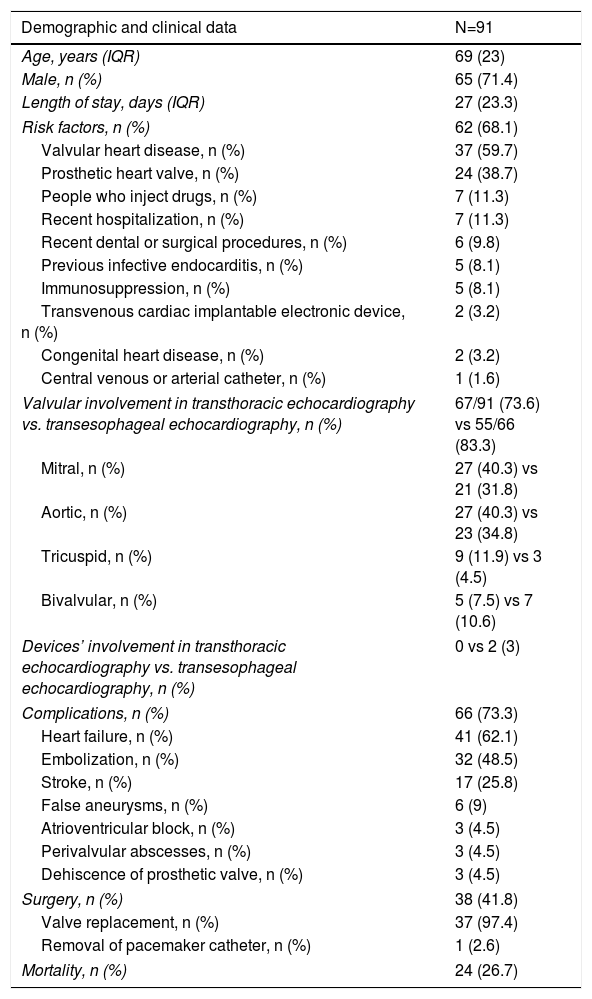
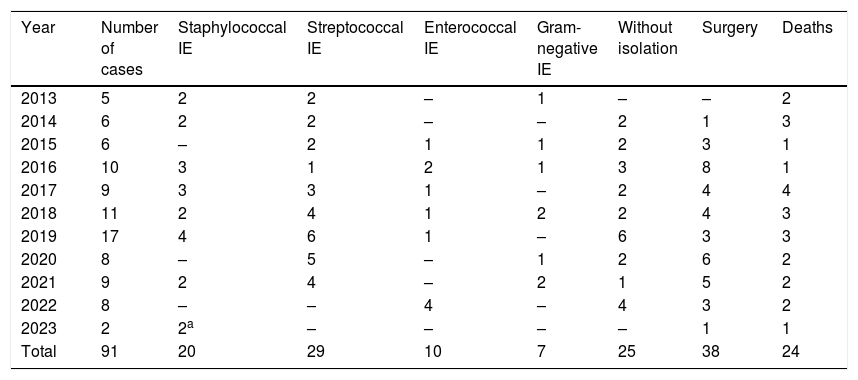
We included 91 patients, 65 (71.4%) of whom were male with a median age of 69 years (Table 1). The most prevalent risk factor was pre-existing native valve disease. The median serum creatinine was 0.9 mg/dL (range 0.5–3.8 mg/dL), corresponding to a median glomerular filtration rate of 71 mL/min/1.73 m2 (minimum 11 mL/min/1.73 m2). All patients underwent transthoracic echocardiography. Univalvular involvement occurred in 80.6%, and multivalvular disease in 7.5%. Transesophageal echocardiography was performed in 55 patients (60.4%), computed tomography in one and positron emission tomography in nine patients. Blood cultures were obtained for all patients, with a microbiology identification in 72.5% (Table 2). Among the 25 patients with blood culture-negative IE, three had received antibiotic therapy. No fungi or fastidious bacteria were isolated. 66 patients (73.3%) experienced complications. Of the 42 patients with a surgical indication, valvular surgery was performed in 90.5% (n=38), and pacemaker lead extraction in 2.6%. The median interval from diagnosis to intervention was 11 days (range: 0–210 days). Overall, in-hospital mortality was 26.4% (n=24). Mortality among patients managed exclusively with medical therapy was more than four times higher (39.6% vs 7.9%). There was a significant age gap between these two groups (73 vs 61, p=0.007). Admission serum creatinine was significantly higher in patients who died versus survivors (1.4 vs 0.9 mg/dL; p=0.012).
Summary of reported demographic and clinical data.
| Demographic and clinical data | N=91 |
|---|---|
| Age, years (IQR) | 69 (23) |
| Male, n (%) | 65 (71.4) |
| Length of stay, days (IQR) | 27 (23.3) |
| Risk factors, n (%) | 62 (68.1) |
| Valvular heart disease, n (%) | 37 (59.7) |
| Prosthetic heart valve, n (%) | 24 (38.7) |
| People who inject drugs, n (%) | 7 (11.3) |
| Recent hospitalization, n (%) | 7 (11.3) |
| Recent dental or surgical procedures, n (%) | 6 (9.8) |
| Previous infective endocarditis, n (%) | 5 (8.1) |
| Immunosuppression, n (%) | 5 (8.1) |
| Transvenous cardiac implantable electronic device, n (%) | 2 (3.2) |
| Congenital heart disease, n (%) | 2 (3.2) |
| Central venous or arterial catheter, n (%) | 1 (1.6) |
| Valvular involvement in transthoracic echocardiography vs. transesophageal echocardiography, n (%) | 67/91 (73.6) vs 55/66 (83.3) |
| Mitral, n (%) | 27 (40.3) vs 21 (31.8) |
| Aortic, n (%) | 27 (40.3) vs 23 (34.8) |
| Tricuspid, n (%) | 9 (11.9) vs 3 (4.5) |
| Bivalvular, n (%) | 5 (7.5) vs 7 (10.6) |
| Devices’ involvement in transthoracic echocardiography vs. transesophageal echocardiography, n (%) | 0 vs 2 (3) |
| Complications, n (%) | 66 (73.3) |
| Heart failure, n (%) | 41 (62.1) |
| Embolization, n (%) | 32 (48.5) |
| Stroke, n (%) | 17 (25.8) |
| False aneurysms, n (%) | 6 (9) |
| Atrioventricular block, n (%) | 3 (4.5) |
| Perivalvular abscesses, n (%) | 3 (4.5) |
| Dehiscence of prosthetic valve, n (%) | 3 (4.5) |
| Surgery, n (%) | 38 (41.8) |
| Valve replacement, n (%) | 37 (97.4) |
| Removal of pacemaker catheter, n (%) | 1 (2.6) |
| Mortality, n (%) | 24 (26.7) |
Legend: IQR: interquartile range.
Number of cases, microbiologic isolations, surgeries and deaths divided by year.
| Year | Number of cases | Staphylococcal IE | Streptococcal IE | Enterococcal IE | Gram-negative IE | Without isolation | Surgery | Deaths |
|---|---|---|---|---|---|---|---|---|
| 2013 | 5 | 2 | 2 | – | 1 | – | – | 2 |
| 2014 | 6 | 2 | 2 | – | – | 2 | 1 | 3 |
| 2015 | 6 | – | 2 | 1 | 1 | 2 | 3 | 1 |
| 2016 | 10 | 3 | 1 | 2 | 1 | 3 | 8 | 1 |
| 2017 | 9 | 3 | 3 | 1 | – | 2 | 4 | 4 |
| 2018 | 11 | 2 | 4 | 1 | 2 | 2 | 4 | 3 |
| 2019 | 17 | 4 | 6 | 1 | – | 6 | 3 | 3 |
| 2020 | 8 | – | 5 | – | 1 | 2 | 6 | 2 |
| 2021 | 9 | 2 | 4 | – | 2 | 1 | 5 | 2 |
| 2022 | 8 | – | – | 4 | – | 4 | 3 | 2 |
| 2023 | 2 | 2a | – | – | – | – | 1 | 1 |
| Total | 91 | 20 | 29 | 10 | 7 | 25 | 38 | 24 |
IE: infective endocarditis.
The epidemiological and clinical profile of this cohort aligns with contemporary trends. The male predominance and median age reflect the demographic profile of IE documented in recent studies.1–3 While Staphylococcus aureus and Streptococcus spp. remained predominant pathogens, the increased isolation of Enterococcus spp. parallels patterns reported in national and European registries.1–4
Three key findings merit emphasis. First, only one methicillin-resistant S. aureus case was identified, consistent with other Portuguese medical series,3 but contrasts with higher resistance rates reported internationally.5 This may reflect Portugal's structured antibiotic stewardship initiatives. However, cases due to Enterococcus spp. should not be underestimated, as corroborated by other Portuguese series.1,2,6 Second, blood culture-negative cases exceeded rates in contemporary multicenter registries, highlighting persistent diagnostic challenges and suggesting a potential role for expanded molecular testing for fastidious pathogens. Third, the 50% surgical intervention rate aligns with Portuguese tertiary centers,1 a noteworthy finding considering our institution's status as a local center, but remains below European averages, reflecting differences in patient comorbidities, delayed referrals, or higher rejection rates from specialized centers.5 Differences in mortality between medical and surgical management reinforce surgery's established protective role in IE outcomes, though this likely reflects selection bias favoring lower-risk surgical candidates.2,6 The overall in-hospital mortality exceeds national averages (around 22%) reported in medical series, potentially influenced by this cohort's higher complication burden or center-specific characteristics, and also the small sample size.
Study limitations include its design, potential underdetection of fastidious pathogens and absence of long-term follow-up. Strengths encompass rigorous application of modified Duke criteria, microbiological documentation, and high adherence to surgical guidelines.
This analysis highlights epidemiological trends consistent with national patterns, including an aging population and evolving microbial ecology with emergence of Enterococcus spp. Blood culture-negative IE remains a diagnostic challenge, suggesting the need for molecular diagnostics. Despite its limitations, this study provides valuable insights into the contemporary IE landscape in Portugal and supports establishing multidisciplinary IE teams, national registries, and surgical referral pathways to standardize management and improve outcomes.
FundingNone to declare.
Conflicts of interestThe authors have no conflicts of interest to declare.