
Current guidelines recommend a stepwise, low-density lipoprotein cholesterol (LDL-C) guided lipid-lowering therapy (LLT) approach for patients after acute coronary syndrome (ACS). This study aimed to assess whether an early intensive “strike early, strike strong” strategy with upfront combination LLT improves LDL-C goal attainment.
MethodsThis single-center retrospective study included 211 consecutive ACS patients admitted between January and October 2020, with a median follow-up of six months. Metabolic profiles were assessed during hospitalization and at follow-up. Patients were grouped by follow-up LDL-C levels (<55 mg/dL and ≥55 mg/dL). Discharge medication, adherence, and LDL-C reduction were compared.
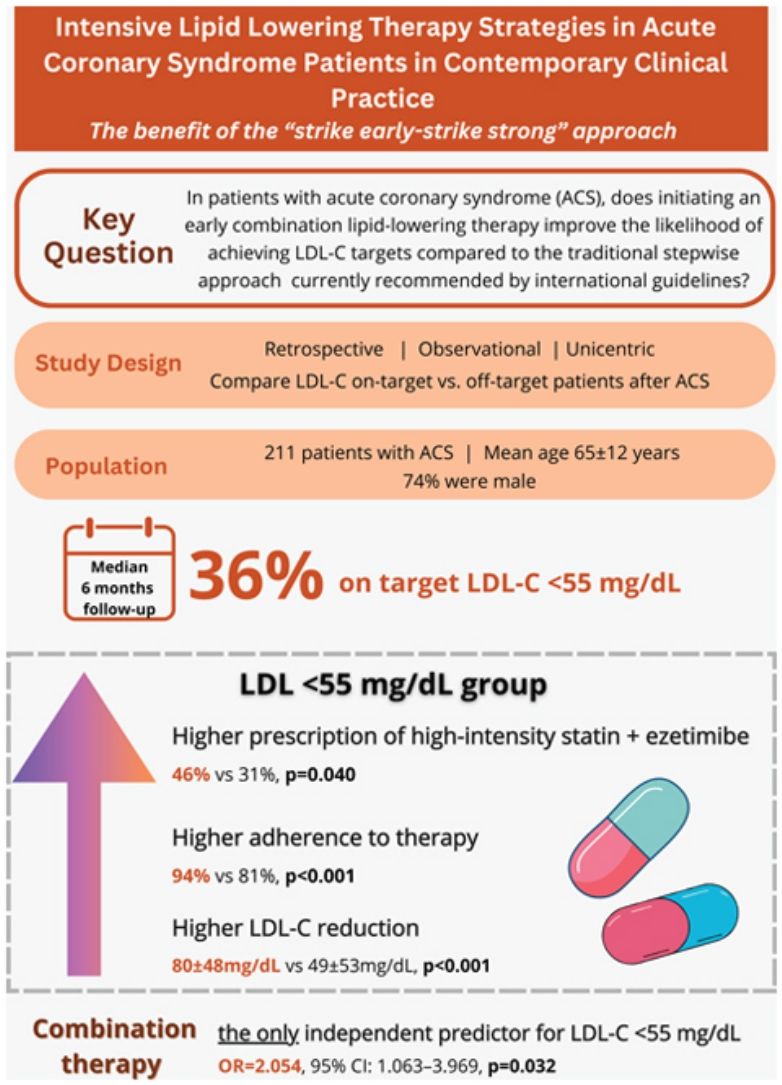
ResultsA total of 211 patients were included in the analysis, with a mean age of 65±12 years; 74% were male. LDL-C on target (<55 mg/dL) was achieved in 36% of patients during a median follow-up of six months. This group was more commonly medicated with combination therapy [high-intensity statin (HI-statin) plus ezetimibe] at discharge (46% vs. 31%, p=0.040), had higher adherence rates (94% vs. 81%, p<0.001) and had significantly greater LDL-C reduction (80±48 mg/dL vs. 49±53 mg/dL, p<0.001). The combination therapy was the only independent predictor for LDL-C on target during follow-up (OR=2.054, 95% CI: 1.063–3.969, p=0.032).
Conclusion(s)Low-density lipoprotein target attainment was suboptimal at median follow-up of six months. The LDL-C target group was associated with combination therapy with HI-statins plus ezetimibe upfront, better adherence and greater LDL-C reduction. These findings support the “strike early, strike strong” approach in very high-risk patients.
As diretrizes atuais recomendam uma terapêutica hipolipemiante gradual do colesterol LDL (C-LDL) para doentes pós-síndrome coronária aguda (SCA). Uma estratégia mais agressiva inicialmente pode beneficiar os resultados. Este estudo foi desenhado para avaliar esta hipótese.
MétodosEstudo retrospetivo que incluiu 211 doentes admitidos com SCA (janeiro e outubro de 2020), com um seguimento mediano de 6 meses. Os perfis metabólicos foram avaliados durante a hospitalização e no seguimento em consulta. Foram constituídos dois grupos de acordo com o valor de C-LDL na consulta de seguimento (<55mg/dL e ≥55mg/dL). A medicação de alta, a adesão à terapêutica e a redução do C-LDL foram comparadas.
ResultadosUm total de 211 pacientes foi incluído na análise, com uma idade média de 65±12 anos e 74% do sexo masculino. C-LDL no alvo (<55mg/dL) foi atingido em 36% dos doentes. Este grupo recebeu mais frequentemente terapêutica hipolipemiante combinada [estatina de alta intensidade (EAI) mais ezetimiba] à data da alta (46% vs 31%, p=0.040), teve maior taxa de adesão à terapêutica (94% vs 81%, p<0.001) e maior redução no C-LDL no seguimento (80±48mg/dl vs 49±53mg/dL, p<0.001). A terapêutica combinada mostrou-se o único preditor independente de se atingir o alvo de LDL durante o seguimento (OR=2.054, 95% CI: 1.063–3.969, p=0.032).
ConclusãoO objetivo de LDL no alvo mostrou um resultado subótimo no seguimento mediano a 6 meses. Valores de C-LDL no alvo estiveram associados a uma terapêutica hipolipemiante combinada ad initium com EAI e ezetimiba, melhor adesão à terapêutica e maior redução absoluta do C-LDL. Estes resultados suportam a estratégia “strike early, strike strong” nestes doentes.

Patients who have experienced acute coronary syndrome (ACS) are at very high risk for recurrent cardiovascular events, with a 20% chance of recurrence within two years and a five-year mortality rate ranging from 19% to 22%. The risk is particularly high within the first months after the first event.1,2
Effective management of cardiovascular risk factors is crucial for preventing recurrence of cardiovascular events. A strong correlation between low-density lipoprotein cholesterol (LDL-C) levels and the risk of atherosclerotic cardiovascular disease (ASCVD) has been established, with a 22% risk reduction across all major vascular events per 1 mmol/L reduction in LDL-C with statins.3 Consequently, LDL-C reduction is particularly relevant in secondary prevention in patients with a history of ASCVD.1,4,5
Current European Society of Cardiology (ESC) guidelines (2019 ESC/EAS Guidelines for the management of dyslipidemias and 2023 ESC Guidelines for the management of acute coronary syndromes) advocate for a stepwise, LDL-C-guided lipid-lowering therapy (LLT), by prioritizing the achievement of specific LDL-C targets to minimize cardiovascular risk.6,7 For patients at very-high risk, the goal is a therapeutic regimen that achieves ≥50% LDL-C reduction from baseline and an LDL-C goal of <55 mg/dL. These guidelines support a “the lower the better” strategy, emphasizing that lower LDL-C levels are associated with better outcomes, with no evidence of a lower limit for benefit. This strategy encourages early and ongoing treatment adjustments to rapidly achieve and maintain target LDL-C goals.8
High intensity statins (HI-statins) remain the cornerstone of treatment, as the first-line therapy, and increasing statin doses and addition of other lipid-lowering agents, such as ezetimibe and proprotein convertase subtilisin/kexin type 9 (PCSK9) inhibitors, should be prescribed in a stepwise manner if follow-up LDL-C remains above target.7 However, the recommended stepwise approach often falls short, leaving patients with a residual risk.1
In Europe, the percentage of post-ACS patients who reach the recommended LDL-C targets is low, with studies indicating fewer than 20% of patients.9 Despite this, after multiple revisions, ESC/EAS recommendations continue to endorse a stepwise, gradual intensification of lipid-lowering therapy to achieve the LDL-C target.
The latest clinical consensus statement from the Acute Cardiovascular Care (ACVC) program focuses on the importance of early and aggressive LDL-C reduction in patients following an ACS. An alternative “strike early, strike strong” approach, advocated by Krychtiuk et al., involving upfront combination therapy with HI-statins and ezetimibe has been proposed to enhance lipid control and potentially improve outcomes. This strategy is a proactive approach to lipid management that aims to rapidly and substantially lower LDL-C levels after an acute event, before plaque progression and clinical events occur.1 Therefore, evidence supports that a more aggressive approach to lipid management, characterized by the “strike early, strike strong” in addition to “the lower the better”, results in improved LDL-C control and cardiovascular outcomes.8
ObjectivesThis study aims to provide a comprehensive analysis of the lipid profiles and discharge LLT of post-MI patients treated at a cardiology department from a district general hospital.
MethodsSelection and description of participantsThis retrospective single-center cohort study included ACS patients admitted consecutively between January 2020 and October 2020.
Patients were eligible for the study if they were ≥18 years of age and were hospitalized with a diagnosis of ACS. Patients were excluded if they had no follow-up (mostly non-residents) or had missing key data.
Data collection and measurementsData collected included demographics, diagnosis at admission, medical history, metabolic profile (including total cholesterol, LDL-C, high density lipoprotein (HDL)-C, triglycerides), previous use of HI-statin and discharge LLT. Patients were grouped based on their LDL-C levels (<55 mg/dL and ≥55 mg/dL) at the first follow-up visit, which occurred within a median time of 6 months. Adherence to the prescribed LLT was assessed through direct questioning during follow-up consultations and by monitoring prescription usage via the electronic prescription portal. No valid questionnaires for medication adherence were used.
All ethical requirements in the Helsinki Declaration of 1975 were met. The present study has been approved by the ethics committee of the hospital center.
OutcomesThe primary outcome was to compare LLT strategies between two groups: a group with LDL-C on target (defined as LDL-C <55 mg/dL) versus LDL-C off target (defined as LDL-C ≥55 mg/dL) in a median 6-month follow-up. Secondary outcomes were to assess LDL-C absolute reduction and therapy adherence between groups, and to identify independent predictors of LDL-C on target at follow-up.
StatisticsDescriptive statistics were used to summarize patient characteristics. Categorical variables are presented as frequencies and percentages, and continuous variables as means and standard deviations, or medians and interquartile ranges for variables with skewed distribution or a significant Shapiro–Wilk test. Comparisons between the two LDL-C groups were performed using appropriate statistical tests (e.g., Student t-tests for continuous variables, chi-square tests for categorical variables). Multivariate analysis was performed using logistic regression to identify predictors significantly associated with the outcomes. The variables included in the model were age, gender, BMI, combined use of HI-statins and ezetimibe, and smoking habits. p-Values <0.05 were considered statistically significant. Statistical analysis was performed using IBM SPSS Statistics (IBM SPSS, Chicago, IL, USA, version 21.0).
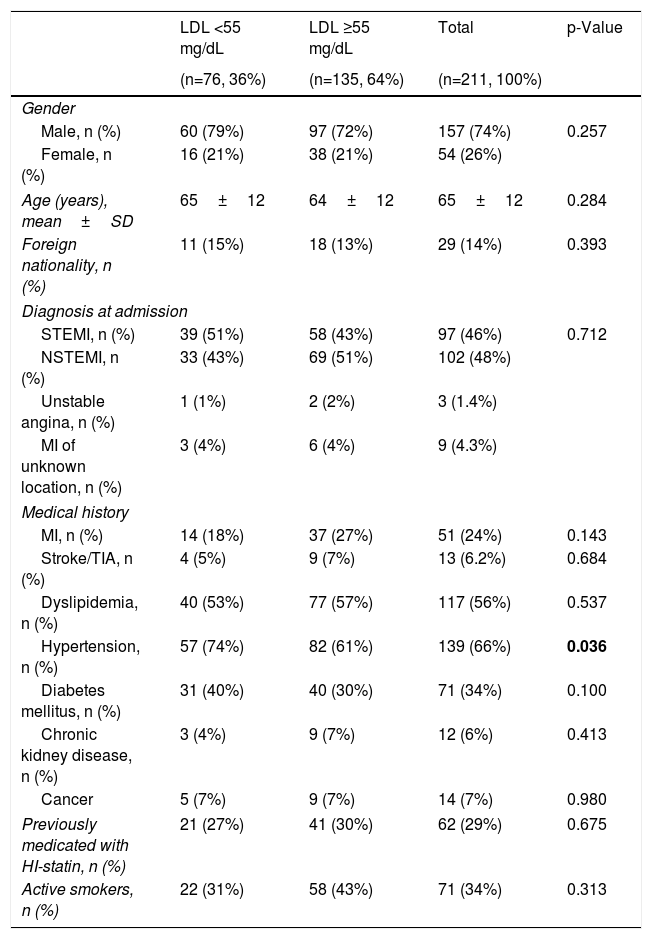
ResultsPopulation characterizationThis cohort included 211 consecutive ACS patients. Baseline demographic and clinical data are presented in Table 1. The population had a mean age of 65±12 years and 74% of the patients were male.
Baseline characteristics of post-ACS patients, according to follow-up LDL-C.
| LDL <55 mg/dL | LDL ≥55 mg/dL | Total | p-Value | |
|---|---|---|---|---|
| (n=76, 36%) | (n=135, 64%) | (n=211, 100%) | ||
| Gender | ||||
| Male, n (%) | 60 (79%) | 97 (72%) | 157 (74%) | 0.257 |
| Female, n (%) | 16 (21%) | 38 (21%) | 54 (26%) | |
| Age (years), mean±SD | 65±12 | 64±12 | 65±12 | 0.284 |
| Foreign nationality, n (%) | 11 (15%) | 18 (13%) | 29 (14%) | 0.393 |
| Diagnosis at admission | ||||
| STEMI, n (%) | 39 (51%) | 58 (43%) | 97 (46%) | 0.712 |
| NSTEMI, n (%) | 33 (43%) | 69 (51%) | 102 (48%) | |
| Unstable angina, n (%) | 1 (1%) | 2 (2%) | 3 (1.4%) | |
| MI of unknown location, n (%) | 3 (4%) | 6 (4%) | 9 (4.3%) | |
| Medical history | ||||
| MI, n (%) | 14 (18%) | 37 (27%) | 51 (24%) | 0.143 |
| Stroke/TIA, n (%) | 4 (5%) | 9 (7%) | 13 (6.2%) | 0.684 |
| Dyslipidemia, n (%) | 40 (53%) | 77 (57%) | 117 (56%) | 0.537 |
| Hypertension, n (%) | 57 (74%) | 82 (61%) | 139 (66%) | 0.036 |
| Diabetes mellitus, n (%) | 31 (40%) | 40 (30%) | 71 (34%) | 0.100 |
| Chronic kidney disease, n (%) | 3 (4%) | 9 (7%) | 12 (6%) | 0.413 |
| Cancer | 5 (7%) | 9 (7%) | 14 (7%) | 0.980 |
| Previously medicated with HI-statin, n (%) | 21 (27%) | 41 (30%) | 62 (29%) | 0.675 |
| Active smokers, n (%) | 22 (31%) | 58 (43%) | 71 (34%) | 0.313 |
ACS: acute coronary syndrome; HI-statin: high intensity statin; LDL-C: low-density lipoprotein cholesterol; MI: myocardial infarction; NSTEMI: non-ST segment elevation myocardial infarction; SD: standard deviation; STEMI: ST segment elevation myocardial infarction.
Bold lettering indicates statistical significance (p < 0.05).
The LDL <55 mg/dL group represented 36% of the population, while the remaining 64% were in the LDL ≥55 mg/ dL group.
There were no statistically significant differences between groups in terms of gender, with males comprising 79% of the LDL<55 mg/dL group and 72% of the LDL ≥55 mg/dL group (p=0.257). The mean age was comparable between groups (65±12 vs. 64±12 years; p=0.284), and the proportion of patients with foreign nationality was similar (15% vs. 13%; p=0.393).
Regarding the diagnosis at admission, both groups presented similar distributions of ST-segment elevation myocardial infarction (MI) (STEMI: 51% vs. 43%; p=0.712), non-ST-segment elevation MI (NSTEMI: 43% vs. 51%; p=0.712), unstable angina (1% vs. 2%; p=0.712), and MI of unknown location (4% in both groups; p=0.712).
In terms of past medical history, the prevalence of previous MI (18% vs. 27%; p=0.143), stroke or transient ischemic attack (5% vs. 7%; p=0.684), dyslipidemia (53% vs. 57%; p=0.537), diabetes mellitus (40% vs. 30%; p=0.100), chronic kidney disease (4% vs. 7%; p=0.413), and cancer (7% in both groups; p=0.980) was comparable. However, hypertension was significantly more prevalent among patients who achieved LDL <55mg/dL (75% vs. 61%; p=0.036).
No significant differences were observed regarding previous use of HI-statins (27% vs. 30%; p=0.675) or the proportion of active smokers (31% vs. 43%; p=0.313) between groups.
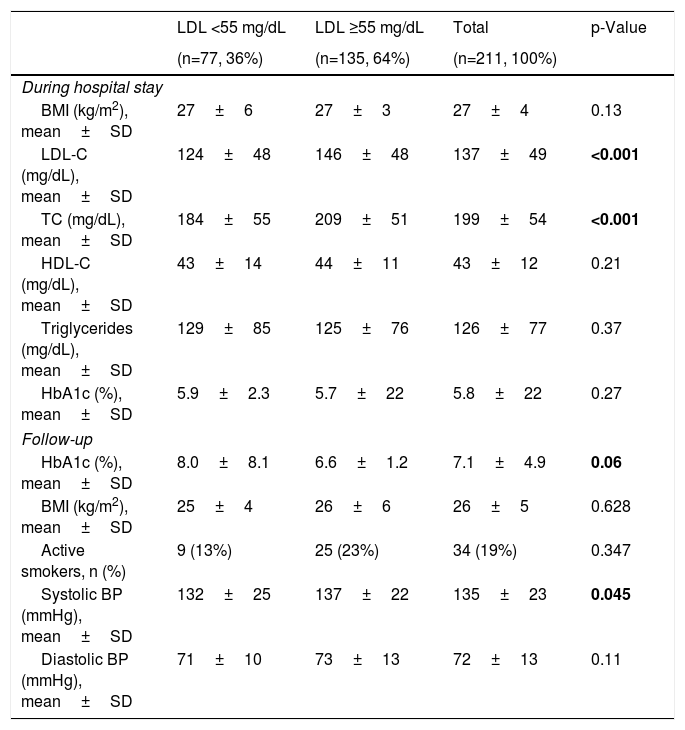
Metabolic profile during hospitalization and follow-upThe metabolic profiles of patients, according to LDL-C levels at follow-up (<55 mg/dL vs. ≥55 mg/dL), are presented in Table 2.
Metabolic profile during hospitalization and follow-up, according to follow-up LDL-C.
| LDL <55 mg/dL | LDL ≥55 mg/dL | Total | p-Value | |
|---|---|---|---|---|
| (n=77, 36%) | (n=135, 64%) | (n=211, 100%) | ||
| During hospital stay | ||||
| BMI (kg/m2), mean±SD | 27±6 | 27±3 | 27±4 | 0.13 |
| LDL-C (mg/dL), mean±SD | 124±48 | 146±48 | 137±49 | <0.001 |
| TC (mg/dL), mean±SD | 184±55 | 209±51 | 199±54 | <0.001 |
| HDL-C (mg/dL), mean±SD | 43±14 | 44±11 | 43±12 | 0.21 |
| Triglycerides (mg/dL), mean±SD | 129±85 | 125±76 | 126±77 | 0.37 |
| HbA1c (%), mean±SD | 5.9±2.3 | 5.7±22 | 5.8±22 | 0.27 |
| Follow-up | ||||
| HbA1c (%), mean±SD | 8.0±8.1 | 6.6±1.2 | 7.1±4.9 | 0.06 |
| BMI (kg/m2), mean±SD | 25±4 | 26±6 | 26±5 | 0.628 |
| Active smokers, n (%) | 9 (13%) | 25 (23%) | 34 (19%) | 0.347 |
| Systolic BP (mmHg), mean±SD | 132±25 | 137±22 | 135±23 | 0.045 |
| Diastolic BP (mmHg), mean±SD | 71±10 | 73±13 | 72±13 | 0.11 |
BMI: body mass index; BP: blood pressure; HbA1C: glycated hemoglobin; LDL-C: low-density lipoprotein cholesterol; SD: standard deviation.
Bold lettering indicates statistical significance (p < 0.05).
Patients who achieved LDL <55 mg/dL at follow-up presented significantly lower baseline lipid values during the hospital stay, including LDL-C (124±48 vs. 146±48 mg/dL; p<0.001) and total cholesterol (184±55 vs. 209±51 mg/dL; p<0.001). No significant differences were observed for body mass index (BMI) (27±6 vs. 27±3 kg/m2; p=0.13), high density lipoprotein (HDL)-C (43±14 vs. 44±11 mg/dL; p=0.21), triglycerides (129±85 vs. 125±76 mg/dL; p=0.37), or glycated hemoglobin (HbA1c) (5.9±2.3% vs. 5.7±2.2%; p=0.27).
During follow-up, systolic BP was slightly but significantly lower in the LDL <55 mg/dL group (132±25 vs. 137±22 mmHg; p=0.045), whereas no significant differences were noted for diastolic BP (71±10 vs. 73±13 mmHg; p=0.11), BMI (25±4 vs. 26±6 kg/m2; p=0.628), active smoking (13% vs. 23%; p=0.347) or HbA1c (8.0±8.1% vs. 6.6±1.2%; p=0.06).
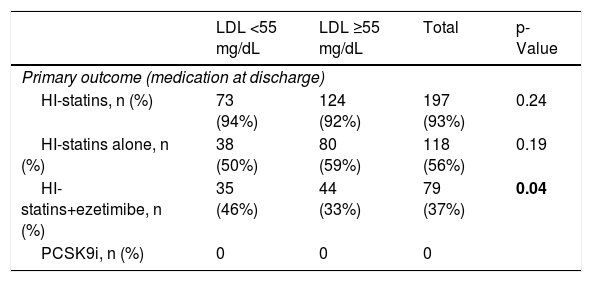
OutcomesOn discharge, HI-statins were prescribed to the majority of patients in both groups (94% vs. 92%; p=0.24). However, combination therapy with HI-statins plus ezetimibe was significantly more frequently prescribed in the LDL <55 mg/dL group (46% vs. 33%; p=0.04). HI-statins monotherapy was used in 50% of the LDL <55 mg/dL group and 59% of the LDL ≥55 mg/dL group (p=0.19). No patients were discharged with a proprotein convertase subtilisin/kexin type 9 inhibitors (PCSK9i) in either group (Table 3).
Primary outcome, according to follow-up LDL-C.
| LDL <55 mg/dL | LDL ≥55 mg/dL | Total | p-Value | |
|---|---|---|---|---|
| Primary outcome (medication at discharge) | ||||
| HI-statins, n (%) | 73 (94%) | 124 (92%) | 197 (93%) | 0.24 |
| HI-statins alone, n (%) | 38 (50%) | 80 (59%) | 118 (56%) | 0.19 |
| HI-statins+ezetimibe, n (%) | 35 (46%) | 44 (33%) | 79 (37%) | 0.04 |
| PCSK9i, n (%) | 0 | 0 | 0 | |
HI-statin: high intensity statin; LDL-C: low-density lipoprotein cholesterol; PCSK9i: proprotein convertase subtilisin/kexin type 9 inhibitors.
Bold lettering indicates statistical significance (p < 0.05).
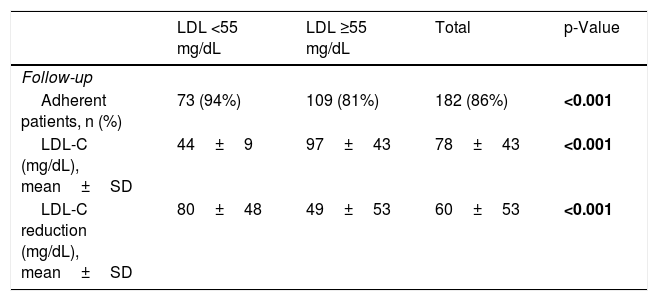
During follow-up (median time of 6 months), patients with LDL-C on target were more likely to report adherence to therapy (94% vs. 81%; p<0.001). These patients also exhibited significantly lower LDL-C levels at follow-up (44±9 vs. 97±43 mg/dL; p<0.001) and a greater absolute reduction in LDL-C from baseline (80±48 vs. 49±53 mg/dL; p<0.001) (Table 4).
Secondary outcomes, according to follow-up LDL-C.
| LDL <55 mg/dL | LDL ≥55 mg/dL | Total | p-Value | |
|---|---|---|---|---|
| Follow-up | ||||
| Adherent patients, n (%) | 73 (94%) | 109 (81%) | 182 (86%) | <0.001 |
| LDL-C (mg/dL), mean±SD | 44±9 | 97±43 | 78±43 | <0.001 |
| LDL-C reduction (mg/dL), mean±SD | 80±48 | 49±53 | 60±53 | <0.001 |
LDL-C: low density lipoprotein cholesterol.
Bold lettering indicates statistical significance (p < 0.05).
Among patients who achieved LDL <55 mg/dL, adherence was higher and similar between those on HI-statins monotherapy or on combination therapy when comparing with adherence rates in the LDL ≥55 mg/dL group (97% and 94% vs. 83% and 79%, respectively, p=0.03) (Table 5).
Analysis on adherence to medication according to follow-up LDL and discharge LLT.
| LDL <55 mg/dL | LDL ≥55 mg/dL | Total | p-Value | ||||
|---|---|---|---|---|---|---|---|
| HI-statin alonen=38 | HI-statin and ezetimiben=35 | HI-statin alonen=80 | HI-statin and ezetimiben=44 | HI-statin alonen=118 | HI-statin and ezetimiben=79 | ||
| Adherent | 37 (97%) | 33 (94%) | 65 (83%) | 34 (79%) | 102 (88%) | 67 (88%) | 0.03 |
HI-statin: high-intensity statin; LDL-C: low-density lipoprotein cholesterol; LLT: lipid lowering therapy.
Bold lettering indicates statistical significance (p < 0.05).
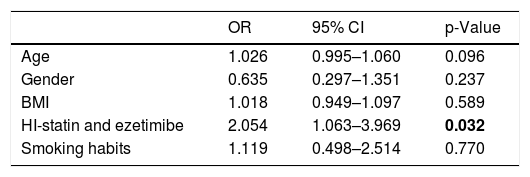
A multivariate logistic regression analysis identifying predictors of LDL cholesterol levels <55 mg/dL is presented in Table 6. Among these, only the use of HI-statins combined with ezetimibe was significantly associated with LDL on target (OR=2.054, 95% CI: 1.063–3.969, p=0.032).
Multivariate analysis (logistic regression) – independent predictors of LDL on target, during follow-up.
| OR | 95% CI | p-Value | |
|---|---|---|---|
| Age | 1.026 | 0.995–1.060 | 0.096 |
| Gender | 0.635 | 0.297–1.351 | 0.237 |
| BMI | 1.018 | 0.949–1.097 | 0.589 |
| HI-statin and ezetimibe | 2.054 | 1.063–3.969 | 0.032 |
| Smoking habits | 1.119 | 0.498–2.514 | 0.770 |
HI-statin: high-intensity statin; BMI: body mass index.
Bold lettering indicates statistical significance (p < 0.05).
The main finding of the present analysis was that, after ACS, patients with LDL-C on target during follow-up were more frequently receiving combination therapy with HI-statins plus ezetimibe and also demonstrated greater adherence to therapy.
It is important to highlight that the majority of patients (64%) failed to achieve the target LDL-C level by the time of the first follow-up visit, with a median time to reassessment of 6 months. These results fall significantly short of current guideline recommendations, which advise an earlier follow-up within 4–6 weeks to allow timely therapeutic adjustment. In practice, however, such timelines are often unrealistic in most healthcare centers, thereby limiting the rapid escalation of LLT and negatively affecting patient adherence.
Overall, the two groups were comparable in terms of medical history and ASCVD, except for a higher prevalence of hypertension in the LDL-C target group. However, significant differences were observed in terms of metabolic profiles: patients who failed to reach the LDL-C target had a more unfavorable metabolic profile at baseline, which should have justified a more intensive therapeutic approach, with combination therapy at the beginning.
HI-statins were widely prescribed in both groups, in line with current recommendations. However, 37% of patients were prescribed upfront combination therapy with HI-statins and ezetimibe, and this therapeutic approach was more frequently observed in those who achieved the LDL-C target during follow-up. Multivariate analysis demonstrated that this combination was the only independent predictor of success in reaching the LDL-C goal, at least doubling the likelihood of achieving the target.
The significant reduction in LDL-C observed in the <55 mg/dL group, coupled with the higher prescription of combination therapy, suggests that early initiation of HI-statins and ezetimibe may be a key driver of improved lipid control. This finding supports the hypothesis that a more aggressive approach to LLT can lead to better outcomes in post-ACS patients. This proactive strategy emphasizes early and aggressive lipid lowering to rapidly achieve target LDL-C levels and minimize the duration of exposure to elevated LDL-C. It is also noteworthy that some cardiovascular risk factors, namely BMI and active smoking, were reduced between admission and follow-up, suggesting that lifestyle modifications may have contributed to the overall risk reduction in both groups.
Additionally, better adherence in the LDL-C <55 mg/dL group suggests that an intensive regimen may improve long-term medication adherence. Although there were no differences in therapeutic adherence according to LLT strategy, in the LDL-C on target group the higher adherence rate observed further underscores the potential benefits of this approach. Improved adherence may stem from factors such as simplified treatment regimens, favorable safety profile, increased patient education, or a greater perceived benefit of combination therapy.
Nonetheless, 44 (33%) patients treated with the HI-statins–ezetimibe combination still failed to meet the LDL-C goal, including in patients who reported good adherence to this strategy (n=34–79%), thereby remaining at increased risk for recurrent cardiovascular events. These patients would likely benefit from tighter follow-up, more rapid escalation of therapy and combination options to achieve target lipid levels as early as possible.
While current ESC guidelines recommend a stepwise approach to LLT, this study supports the use of a “strike early, strike strong” strategy involving upfront combination therapy with HI-statins and ezetimibe.1
This approach appears to be more effective in achieving LDL-C targets, likely due to the potent LDL-C-lowering effects of this combination when coupled with a favorable safety profile.8
ConclusionIn this cohort, LDL-C attainment was suboptimal with only 36% of post-ACS patients achieving LDL-C levels <55 mg/dL at median 6 months follow-up. Patients with LDL on target were more likely to have started combination therapy with HI-statins plus ezetimibe upon discharge with better adherence and greater LDL-C reductions. These findings support the “strike early, strike strong” approach to LLT as a more effective strategy for achieving LDL-C targets in very high-risk patients.
LimitationsSome limitations must be acknowledged. This was an observational study; therefore, collected data were limited to medical records. The retrospective, single-center design introduces potential bias, and the relatively small sample size may limit the generalizability of our findings.
Furthermore, the study did not assess long-term clinical outcomes, such as recurrent cardiovascular events or mortality. Data were collected in 2020, before the “strike early, strike strong” recommendation and also before the simplified access to other intensive therapeutic options, like PCSK9i, which may explain the lower prescription of more intensive lipid-lowering strategies. Future prospective studies with larger, more diverse populations are needed to confirm these findings and evaluate the impact of the “strike early, strike strong” approach on clinical outcomes. Such studies should also explore the potential benefits of even lower LDL-C targets, as suggested by recent research.
Ethical approvalEthics Commission for the Health of the Local Health Unit of the Algarve, Registration number: P33/2025.
Declaration of generative AI and AI-assisted technologies in the writing processDuring the preparation of this work the authors used ChatGPT to improve language and readability. After using this tool, the authors reviewed and edited the content as needed and take full responsibility for the content of the publication.
Conflicts of interestThe authors have no conflicts of interest to declare.
The authors would like to express their gratitude to all colleagues who cooperate in providing data for the current analysis.