
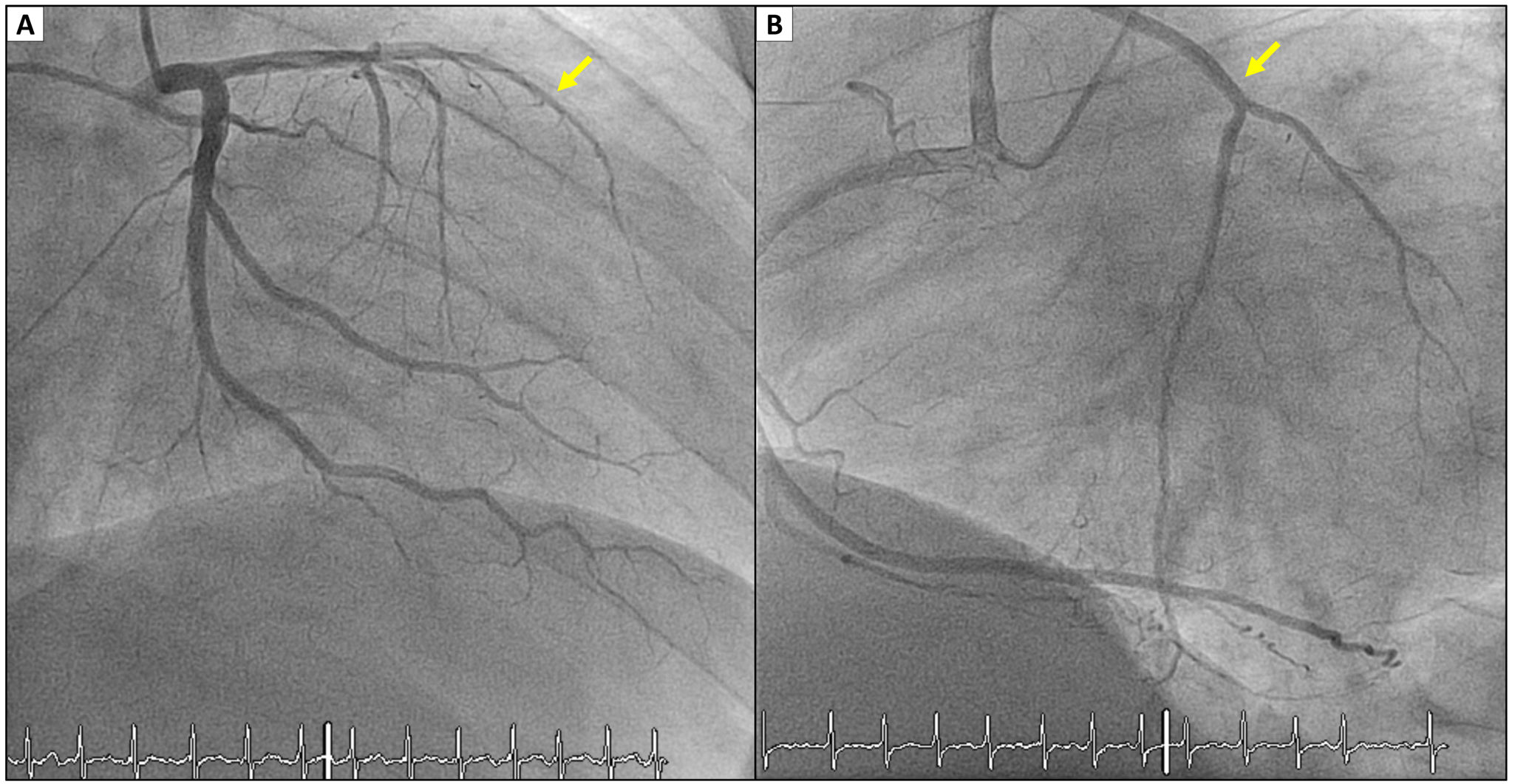
A 57-year-old man with permanent atrial fibrillation and heart failure with reduced ejection fraction (New York Heart Association Class II) was referred for evaluation to determine the underlying cause. Invasive coronary angiography (ICA) revealed no obstructive coronary artery disease; however, it showed an unusual blood supply to the left anterior descending artery (LAD). The proximal LAD originated from the left main (LM) artery, while branches from the right coronary artery (RCA) supplied the mid-to-distal LAD territory (Figure 1).

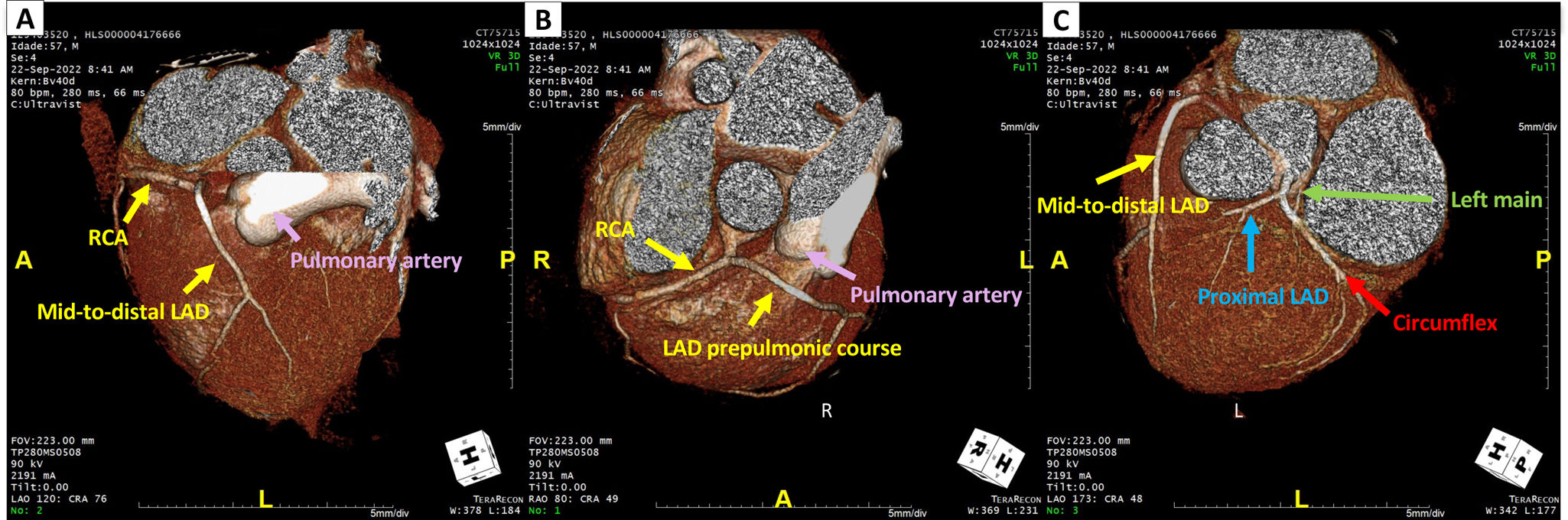
Coronary computed tomography angiography (CCTA) was performed to clarify the anatomical structures. The imaging revealed a dual LAD consistent with the Spindola-Franco Type IV variant, in which a vessel arises from the RCA ostium and follows a prepulmonic course to the anterior interventricular groove, effectively functioning as the “long” LAD. Meanwhile, the proximal (“short”) LAD originates from the left main artery (Figure 2). CCTA is essential for accurately depicting both short and long LAD morphology and course. Dual LAD occurs in approximately 1.3% of contemporary CCTA cohorts, although the Type IV variant remains uncommon. There were no significant stenoses detected.

Coronary computed tomography angiography (CCTA). (A–C) An anomalous LAD segment arising from the right coronary artery (RCA) ostium, taking a prepulmonic course to the anterior interventricular groove, consistent with a “long LAD”. No significant coronary stenosis. (A) Mid-to-distal LAD originating from the RCA (arrow). (B) Prepulmonic course of the LAD. (C) Integrated view: mid-to-distal LAD from the RCA (yellow arrow), proximal LAD (blue arrow) from the left main coronary artery (green arrow), and circumflex artery (red artery).
Given the typically benign prepulmonic course and the clinical context consistent with tachyarrhythmia-induced cardiomyopathy, the coronary anomaly was managed conservatively. This case highlights the role of CCTA in the anatomical classification and risk stratification of dual LAD variants. Accurately identifying a Type IV long LAD originating from the RCA – which is different from malignant interarterial courses – helps prevent unnecessary interventions and guides personalized treatment. Finally, when a short LAD is observed during ICA, the possibility of a dual LAD should be considered to avoid misinterpretation that could compromise the appropriate revascularization strategy.1–5
Informed consentInformed consent was obtained from the patient.
FundingNone declared.
Conflict of interestsThe authors declare no conflicts of interest.